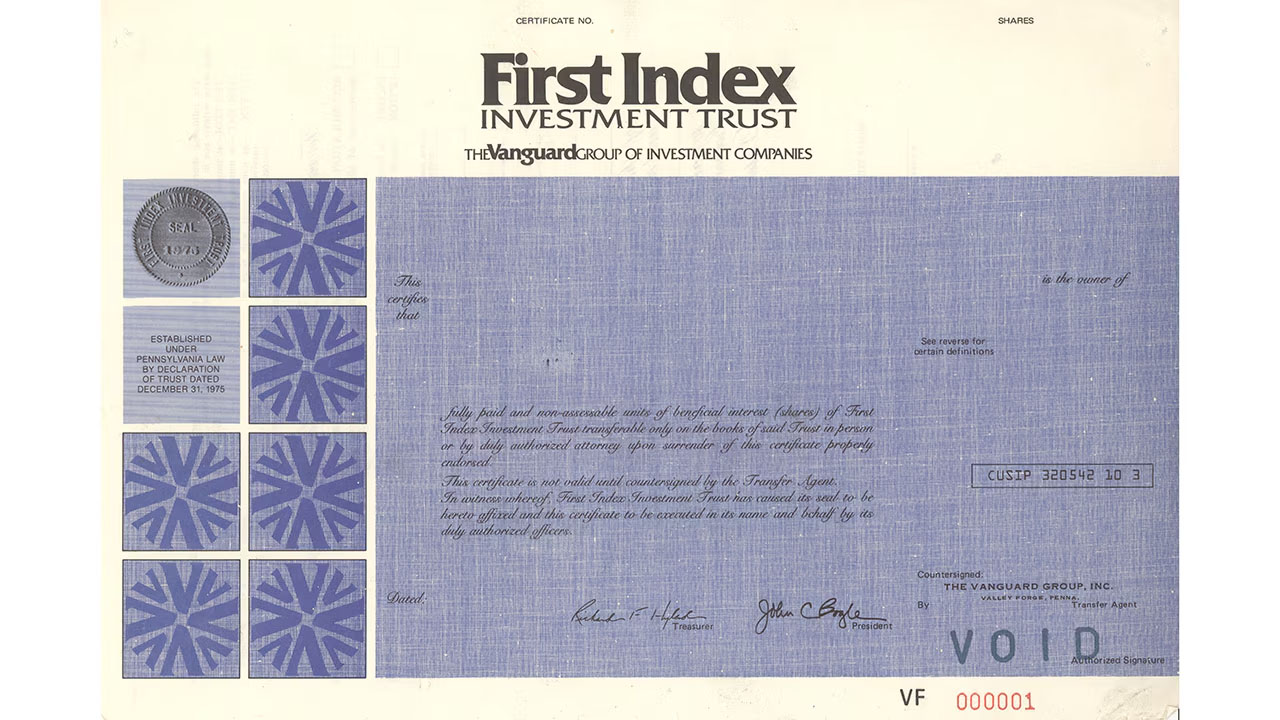
Share certificate for the first index mutual fund, later renamed Vanguard 500 Index Fund.
3.A few months after the launch of First Index Investment Trust, an article in an investment professionals’ journal opened as follows: “An investor seeking expert opinion on index funds might well be confused by what he hears. One conclusion, usually expressed with considerable feeling, is that index funds are a ‘cop-out’ and a fad that will soon disappear. Apparently only a very small minority hold the opposite point of view. They consider index funds the wave of the future ….”2
4.Jan M. Twardowski first led the portfolio management effort. In 1977, shortly after the First Index Investment Trust launched, a reporter for The New York Times wrote that Mr. Twardowski felt “that the fund’s ‘very low’ total operating costs ... will begin to prove more popular with investors.”3
5.Academic support for the strategy preceded the first index-tracking portfolios for institutional investors and Vanguard’s offering for individual investors. In 1973, one such supporter, Princeton University professor Burton S. Malkiel, suggested a new investment instrument: “a no-load, minimum-management-fee mutual fund that simply buys the hundreds of stocks making up the market averages and does no trading (of securities) …. Fund spokesmen are quick to point out, ‘you can’t buy the averages.’ It’s about time the public could.”4
6.In his 1951 undergraduate thesis for Princeton University, Mr. Bogle highlighted the crucial role of costs in the long-term returns earned by investors. He identified costs as a drag on the performance of the industry, which was then entirely actively managed.
7.In the years following 1976, Mr. Bogle famously—and often—advised investors ....