Our economic and market outlook - Alternatives in a portfolio: Think role, risk, and realism
Understanding the potential uncertainty and volatility involved is key when considering alternative assets.

Understanding the potential uncertainty and volatility involved is key when considering alternative assets.
Este artículo está disponible sólo en inglés.
Commentary by Roger Aliaga‑Díaz, Vanguard Global Head of Portfolio Construction, and John Ameriks, Vanguard Head of Quantitative and Strategic Equity
On our “Market views” tab: Earnings momentum builds beyond large-cap tech.
On our “Market views” tab: Putting the 2026 drawdown in context.
On our portfolios page: A new dynamic portfolio
Recent experience in the gold market offers a useful perspective on portfolio construction. It’s not a question of whether gold has “worked,” however. A more fundamental question has come into sharper focus: How should gold or similar alternative investments fit within a long‑term portfolio?
Gold prices reached record highs in early 2026 before retreating sharply, with volatility rising alongside strongly held narratives about its value in a portfolio. For disciplined investors, the lesson was not about forecasting gold’s next move, but rather about clarity—particularly regarding the role alternatives can play in a portfolio, the risk they contribute, and the realism required when thinking about them as diversifiers.
At Vanguard, portfolio construction starts from basic principles. Our core portfolio recommendations are built around assets that generate value through earnings, dividends, and interest. Such portfolios are designed to be resilient across a range of economic environments, including adverse and extreme scenarios. The models that inform them explicitly account for uncertainty, stress, and tail risks.
Assets such as gold, silver, physical commodities, and cryptocurrencies are fundamentally different from traditional investments because they do not generate income or cash flows.1 Their returns depend entirely on changes in price, often influenced by periods of market stress or shifting perceptions around inflation, currencies, and geopolitics.
Because of these characteristics, we believe these types of assets are best evaluated outside a core portfolio rather than embedded within it. That distinction does not imply that investors should avoid alternatives altogether. Many choose to hold them for thoughtful reasons, such as concerns about inflation, potential changes in monetary regimes, or political uncertainty.
But investors frequently make a critical mistake by treating these assets as diversifiers in a way that assumes certainty where only probability exists. When that truth is ignored, gold, commodities, or cryptocurrencies may be implicitly assigned a degree of reliability they cannot deliver.
This is where rigor matters most. Rather than focusing on how much of an asset to own in dollar terms, a more relevant question is how much additional risk an investor is willing to accept relative to a well‑diversified core.
Alternative assets vary widely in volatility. As a result, equal dollar allocations can produce very different risk contributions.
The accompanying figure illustrates why risk contribution—not dollar allocation—is the more meaningful lens for sizing alternatives. Based on Vanguard calculations, it shows how a fixed risk budget of approximately 2% relative to a global portfolio comprising 60% equities and 40% fixed income results in significantly different portfolio weights for each alternative asset, depending on its volatility. In this framework, an investor could allocate about 11.5% to gold, 9.3% to silver, or 3.5% to Bitcoin while remaining within the 2% risk budget. The key takeaway is that even small allocations to volatile assets can quickly dominate portfolio risk, underscoring the need for clear allocation guardrails.
Even a small allocation to a volatile asset can carry big risk
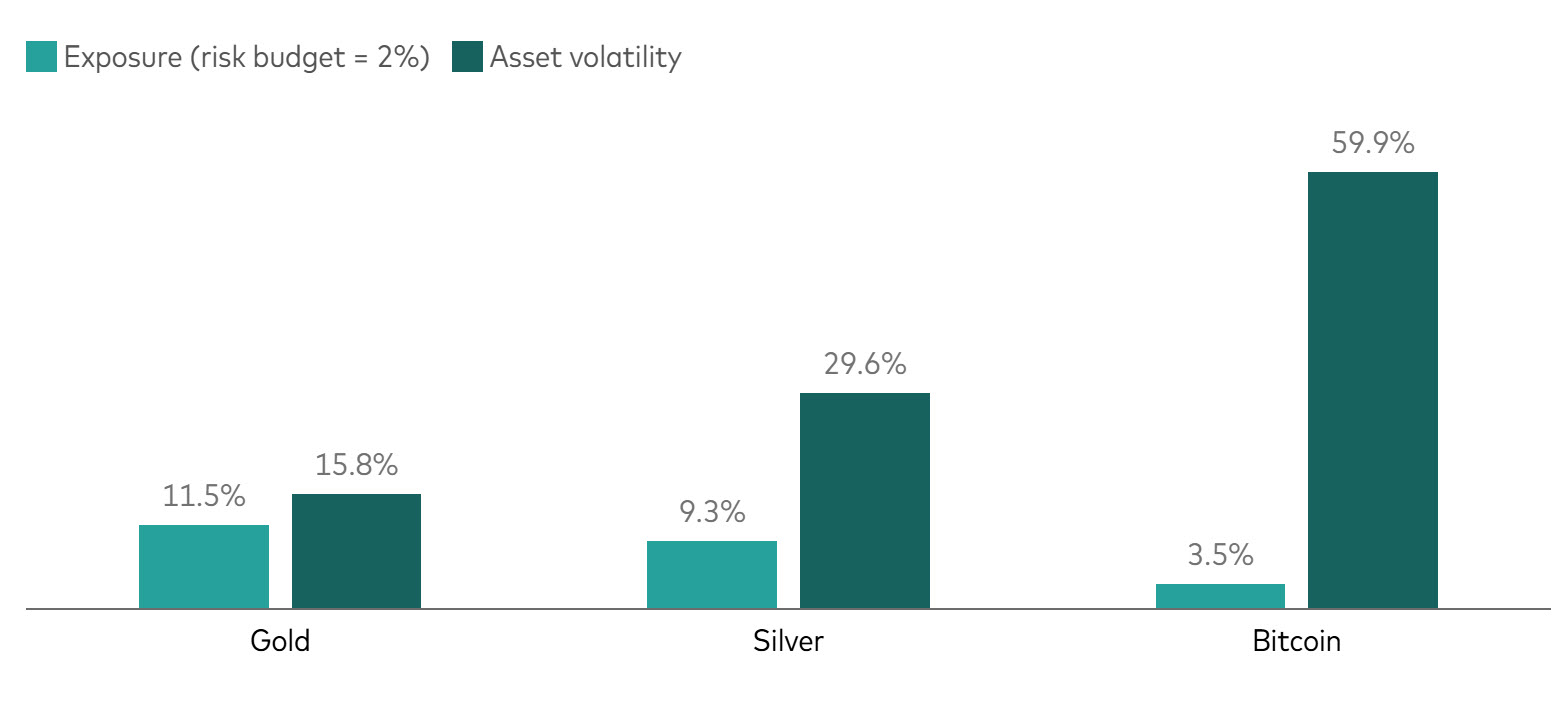
Notes: The risk budget is based on a 2% contribution to total portfolio risk relative to a global 60% equity/40% fixed income portfolio. Gold, silver, and Bitcoin are spot price returns at month-end. Returns and volatility are calculated using nominal prices. Asset volatility is calculated as the annualized standard deviation of monthly returns over the stated sample period. These figures reflect standalone volatility and do not account for correlations with the 60/40 portfolio. The data sample is January 1994 through April 2026 for gold and silver, and January 2021 through April 2026 for Bitcoin. We limit the Bitcoin sample to recent years to acknowledge that volatility has decreased as Bitcoin has grown and matured; otherwise, its volatility would have been greater.
Sources: Vanguard calculations, based on data from Macrobond, Bloomberg, and the Federal Reserve Bank of St. Louis.
Sizing noncore exposures by their contribution to portfolio risk, rather than by dollars invested, helps impose discipline and establish guardrails. A framework that allows for roughly 2%–3% of incremental risk—not a fixed share of the portfolio—can accommodate investor preferences while preserving the integrity of the core holdings.
This also helps ensure that the positions remain proportionate to conviction rather than quietly reshape the portfolio’s risk profile. We don’t recommend traditional rebalancing to fixed portfolio weights, but instead that exposure to alternatives be tied to targeted risk levels.
Gold provides a useful illustration of why realism matters. It is often described as a hedge or store of value, expected to behave defensively during periods of inflation, currency weakness, or geopolitical stress. Historically, gold has often played that role—but not always.
There have been periods when gold experienced sharp drawdowns, extended underperformance, or elevated volatility even as broader portfolio risks were rising. In those environments, what fails is not the asset itself, but the assumption that diversification is reliable under all market scenarios.
Treating gold, or any alternative, as dependable portfolio insurance embeds an expectation that is inconsistent with how diversification actually works. Real-world diversifiers can improve outcomes, on average, and pay off in a manner consistent with their long-term history. But they do not eliminate uncertainty, and history shows they can still fail during periods of stress.
Why disciplined portfolios succeed
The greatest value from alternatives comes not from predicting when they will shine, but from being explicit about their role, honest about their limitations, and disciplined about the risks they introduce.
Clear definitions matter. And clear expectations matter more than compelling narratives.
Alternatives are not essential for disciplined long‑term investing. For investors who choose to include them, recent experience in the gold market reinforces a timeless lesson. Portfolios succeed not because every asset performs consistently, but because uncertainty is acknowledged, risk is managed deliberately, and allocation decisions remain grounded when markets test conviction.
1 Staking protocols or programs enable some cryptocurrencies to generate cash flow. Staking may involve additional risks.
Notes:
All investing is subject to risk, including possible loss of principal.
Bloomberg® and Bloomberg Indexes mentioned herein are service marks of Bloomberg Finance LP and its affiliates, including Bloomberg Index Services Limited (“BISL”), the administrator of the index (collectively, “Bloomberg”) and have been licensed for use for certain purposes by Vanguard. Bloomberg is not affiliated with Vanguard, and Bloomberg does not approve, endorse, review, or recommend the Financial Products included in this document. Bloomberg does not guarantee the timeliness, accurateness, or completeness of any data or information related to the Financial Products included in this document.
Vanguard Mexico is not responsible for and does not prepare, edit, or endorse the content, advertising, products, or other materials on or available from any website owned or operated by a third party that may be linked to this email/document via hyperlink. The fact that Vanguard Mexico has provided a link to a third party's website does not constitute an implicit or explicit endorsement, authorization, sponsorship, or affiliation by Vanguard with respect to such website, its content, its owners, providers, or services. You shall use any such third-party content at your own risk and Vanguard Mexico is not liable for any loss or damage that you may suffer by using third party websites or any content, advertising, products, or other materials in connection therewith.