Our economic and market outlook: Oil shock complicates central bank outlooks
The Middle East conflict continues to keep oil prices elevated, challenging central banks with stagflation risks.

The Middle East conflict continues to keep oil prices elevated, challenging central banks with stagflation risks.
Este artículo está disponible sólo en inglés.
Commentary by Jumana Saleheen, Vanguard European Chief Economist, and Shaan Raithatha, Vanguard Senior Economist.
On our “Market views” tab: Putting the 2026 drawdown in context.
On our portfolios page: A new dynamic portfolio
The Middle East conflict has thrust global central banks into uncomfortable territory. With oil prices having risen above $100 per barrel since the start of the conflict and expected to remain elevated in the weeks ahead, central banks face a challenge: how to respond when inflation accelerates and growth slows simultaneously.
This is a classic stagflationary shock. Oil price increases hit consumers and businesses almost immediately. Drivers feel it at the pump, the cost of transporting goods rises, and price pressures start to ripple through the economy. Households and companies forced to pay more for energy have less to spend and invest, dragging down demand and pressuring economic growth.
Central banks find themselves pulled in opposite directions. Higher inflation implies tightening, but slowing growth implies easing. This high inflation/low growth combination could weigh on both stock and bond prices.
The Federal Reserve, European Central Bank (ECB), Bank of England (BoE), and Bank of Japan (BoJ) are all scheduled to announce policy decisions during the week of April 27. Policy statements will no doubt address the energy shock head on.
The ECB, given its reliance on energy imports, is particularly sensitive to the shock. Although it isn’t our baseline case, this sensitivity could lead the ECB to reverse a rate-cut cycle that took the deposit facility rate from 4% to 2% between June 2024 and June 2025. We have already revised our policy outlook for the U.K. and now expect the BoE to maintain the bank rate at 3.75%, not make two quarter-point cuts in 2026 as we had anticipated before the conflict.
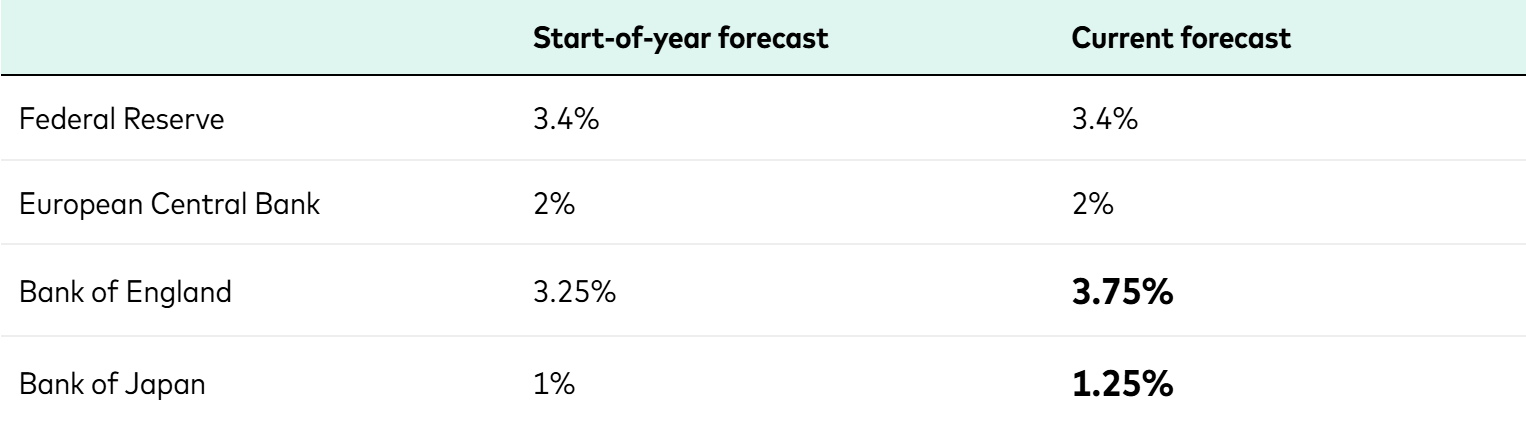
Notes: Forecasts are for monetary policy rates at year-end 2026. The Federal Reserve forecast reflects the rounded midpoint of the Fed’s target policy-rate range.
Source: Vanguard.
We assess U.S. monetary policy to be near neutral, where the policy rate would neither stimulate nor restrict economic activity. Although we continue to expect one quarter-point rate cut in 2026 from the current 3.5%–3.75% range, risks have shifted toward a longer period of policy inertia while the conflict plays out.
The fundamental challenge is timing. While energy prices can surge overnight, monetary policy works with a lag. By the time higher interest rates soften demand—and, by extension, price increases—inflationary pressures may have already taken hold. The conventional wisdom has been to “look through” such supply shocks. But central banks can’t ignore potential knock-on effects. If higher inflation leads workers to demand higher wages, which feeds into broader price pressures, a temporary shock could become persistent. This is why we expect central banks to err on the side of caution in containing inflation.
The path depends on each central bank’s starting point. With inflation having tracked close to its 2% target in recent months and the labor market stable, the ECB finds itself in a stronger position to deal with an inflationary shock than in February 2022, when inflation was already at 6% and the labor market was tight. That recent history could keep the course of policy finely balanced between hiking and holding, with memories of surging inflation still fresh.
Assuming oil prices in a $90–$100 per barrel range and natural gas averaging €60/megawatt-hour for one to two quarters, we upgraded our 2026 ECB headline inflation forecast to 2.5% while lifting our forecast for core inflation—which excludes volatile food and energy prices—more modestly to 2.1%.
The BoE finds itself in more precarious territory. U.K. inflation has been above its 2% target for roughly five years. Core inflation remained above 3% in February 2026 (the March reading is set to be released April 22). Policymakers are still fighting the last battle even as a new one arrives. We recently downgraded our 2026 U.K. GDP forecast by 0.4 percentage points to 0.6%.
The U.S. central bank has greater flexibility. As a net oil exporter, the U.S. is experiencing a smaller shock overall. Higher oil prices hurt consumers but benefit domestic producers. While sticky services inflation and tariff pass-through create complications, the Fed can be patient. The dominant risk is that rates stay higher for longer, not that the Fed tightens policy.
The BoJ, meanwhile, is navigating upward price and policy normalization rather than disinflation. Higher oil prices and yen weakness support that journey by lifting near-term inflation while strong wage growth underpins the broader normalization narrative.
Stagflation is likely to be negative for both stocks and bonds. But assuming a limited duration for the Middle East conflict, we expect medium-term market dynamics to reassert themselves. We also continue to emphasize the potential for AI to be transformative and to spread its benefits throughout economies, as outlined in our 2026 annual outlook.
Notes:
All investing is subject to risk, including possible loss of the money you invest. Be aware that fluctuations in the financial markets and other factors may cause declines in the value of your account. There is no guarantee that any particular asset allocation or mix of funds will meet your investment objectives or provide you with a given level of income. Diversification does not ensure a profit or protect against a loss.
Prices of mid- and small-cap stocks often fluctuate more than those of large-company stocks.
Investments in bonds are subject to interest rate, credit, and inflation risk.
Investments in stocks or bonds issued by non-U.S. companies are subject to risks including country/regional risk and currency risk. These risks are especially high in emerging markets.
The index is a product of S&P Dow Jones Indices LLC, a division of S&P Global, or its affiliates (“SPDJI”), and has been licensed for use by Vanguard. Standard & Poor’s® and S&P® are registered trademarks of Standard & Poor’s Financial Services LLC, a division of S&P Global (“S&P”); Dow Jones® is a registered trademark of Dow Jones Trademark Holdings LLC (“Dow Jones”); and these trademarks have been licensed for use by SPDJI and sublicensed for certain purposes by Vanguard. Vanguard products are not sponsored, endorsed, sold or promoted by SPDJI, Dow Jones, S&P, or their respective affiliates and none of such parties make any representation regarding the advisability of investing in such product(s) nor do they have any liability for any errors, omissions, or interruptions of the index.