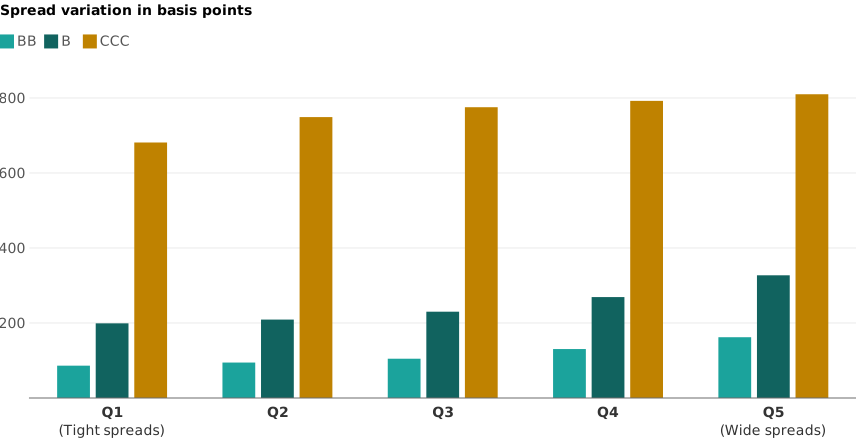
https://www.datawrapper.de/_/6dFBU/
Notes: We used monthly data for the Bloomberg High-Yield Corporate Bond Index for the five-year period from September 30, 2020, through August 31, 2025. The chart displays the monthly cross-sectional standard deviation of spreads within each quality segment. Monthly data are grouped in quintiles (five equal-frequency buckets) based on the asset-weighted headline spread of bonds available in the high-yield market in that month. To better represent an active manager’s opportunity set, we removed all bonds with a zero or negative spread (which can be defaulted or tendered bonds) and those with a spread greater than 5,000 basis points (as default is likely imminent).
Source: Vanguard calculations based on data from Refinitiv as of August 31, 2025.
If you are considering investing in high-yield bond funds, don’t base your decision on average spreads alone. Variation in spreads provides active high-yield bond managers with opportunities to add value. But manager skill and low costs are crucial.
If you can take the heat of added risk, variety is the spice of life, and the source of opportunity for active managers.
The author would like to thank Erich Pingel for his thoughtful discussions and data support.
Notes:
All investing is subject to risk, including the possible loss of the money you invest.
Diversification does not ensure a profit or protect against a loss.
Bond funds are subject to the risk that an issuer will fail to make payments on time, and that bond prices will decline because of rising interest rates or negative perceptions of an issuer's ability to make payments.
High-yield bonds generally have medium- and lower-range credit quality ratings and are therefore subject to a higher level of credit risk than bonds with higher credit quality ratings.
Bloomberg® and Bloomberg Indexes mentioned herein are service marks of Bloomberg Finance LP and its affiliates, including Bloomberg Index Services Limited (“BISL”), the administrator of the index (collectively, “Bloomberg”) and have been licensed for use for certain purposes by Vanguard. Bloomberg is not affiliated with Vanguard and Bloomberg does not approve, endorse, review, or recommend the Financial Products included in this document. Bloomberg does not guarantee the timeliness, accurateness or completeness of any data or information related to the Financial Products included in this document.
Vanguard Mexico is not responsible for and does not prepare, edit, or endorse the content, advertising, products, or other materials on or available from any website owned or operated by a third party that may be linked to this email/document via hyperlink. The fact that Vanguard Mexico has provided a link to a third party's website does not constitute an implicit or explicit endorsement, authorization, sponsorship, or affiliation by Vanguard with respect to such website, its content, its owners, providers, or services. You shall use any such third-party content at your own risk and Vanguard Mexico is not liable for any loss or damage that you may suffer by using third party websites or any content, advertising, products, or other materials in connection therewith.
[1] Credit spreads refer to option-adjusted spreads. Headline spreads refer to asset-weighted average option-adjusted spreads of the Bloomberg High-Yield Corporate Bond Index.
[2] We define dispersion as the standard deviation of spreads for a quality segment in a given month.