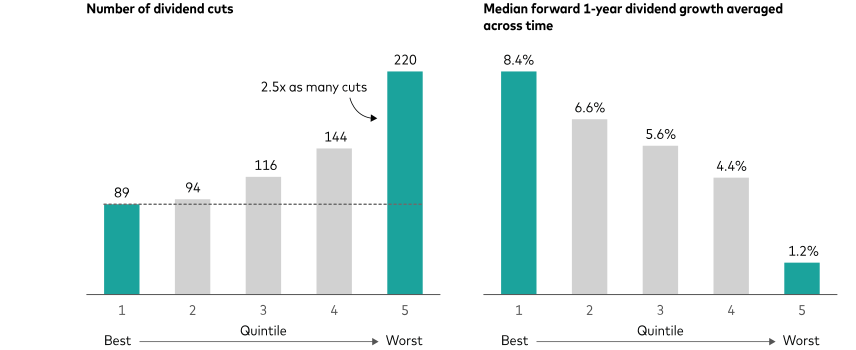
Notes: The HDYU is a custom universe that Vanguard created to include stocks that pay high dividend yields. It consists of the top 60% of dividend yielders in the 2,000 largest stocks by market capitalization in the Russell 3000 Index. Typically, the HDYU includes around 700 stocks.
Source: Vanguard, using financial data from April 2012 through April 2023.
AI for a sharper edge
In the world of investing, even a tiny advantage can affect returns. While companies in the HDYU rarely lower dividends, their stock price tends to suffer when they do, making it advantageous to avoid these companies in strategies focused on dividends.
“Vanguard’s quantitative Equity Income Model is great at capturing numerical information and has shown strong predictive power for future dividend growth,” said Yu Tang, assistant portfolio manager on the Global & Income team. “We wanted to know whether earnings calls could offer additional insights about the strength of a company’s dividend outlook. Recently developed large language models are ideally suited to capture nuanced information that our model may not detect.”
The team used Natural Language Processing techniques to cull relevant dividend discussion snippets from more than 22,000 earnings calls from April 2012 through April 2023 for stocks in the HDYU.
Afterward, team members deployed an open-source large language model (LLM) and prompted the model to analyze the extracted snippets to determine whether companies were likely to grow dividends (a positive outlook), were likely to trim dividends (a negative outlook), or had an unclear outlook on their future dividend.
A real-world example
To understand how this works, let’s consider how the LLM analyzed an actual earnings call. In 2015, an analyst asked a company’s CEO whether its earnings before interest, taxes, depreciation, and amortization were likely to cover the dividend. The executive responded that it was reasonable to argue that the dividend money might be needed elsewhere but didn’t directly answer the question. The language model interpreted this as increasing the odds that the company would decrease its dividend, and just a few months later the company did exactly that.
LLM results echo and complement Vanguard’s quantitative model
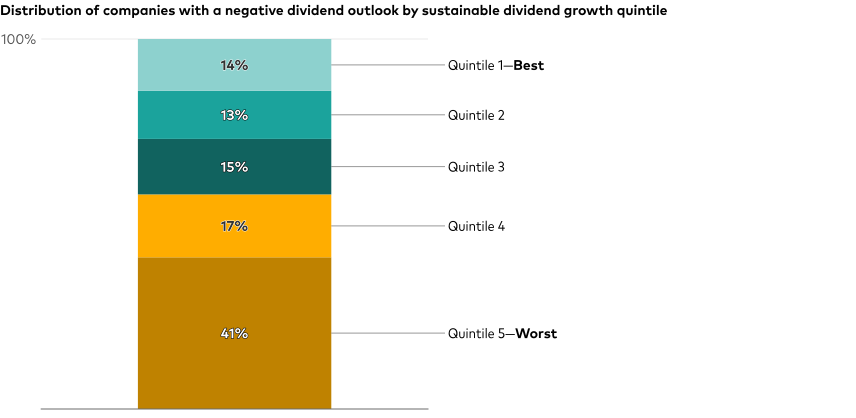
The experiment’s results also validated the effectiveness of Vanguard’s quantitative Equity Income Model. In the next chart, companies in the HDYU are ranked into quintiles based on their sustainable dividend growth score in Vanguard’s Equity Income Model. This score is one of the key determinants of the overall model’s opinion on a stock. Quintile 1 represents stocks with the highest ability to sustain and grow their dividends, and Quintile 5 represents those with the lowest.