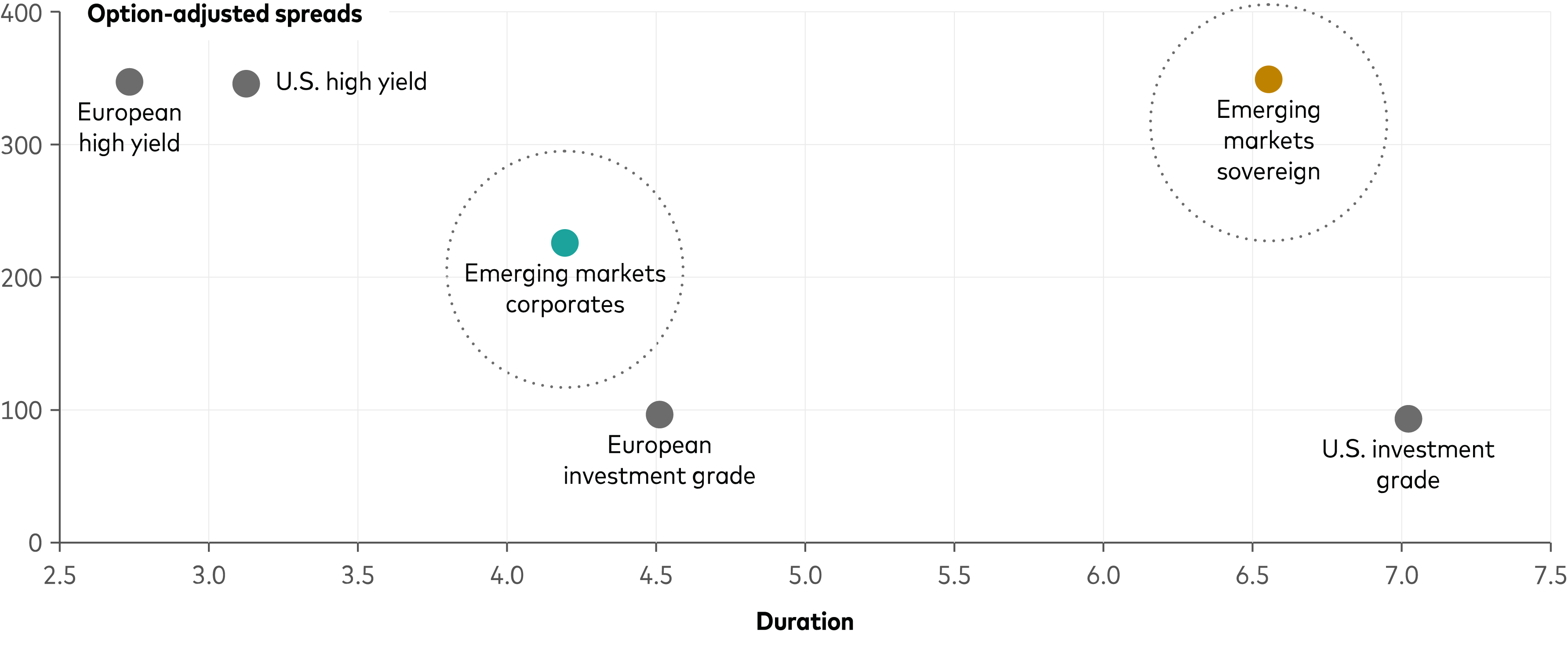
Source: Bloomberg, as of March 19, 2025. Indexes used are: U.S. high yield—ICE BAML US High Yield Index; European high yield—ICE BAML European High Yield Index; European investment grade—Bloomberg Euro Aggregate Corporates Index in EUR; U.S. investment grade—Bloomberg Global Aggregate Corporates US Dollar Index; EM hard currency sovereign—J.P. Morgan EMBI Global Diversified Index; EM corporates—JPM CEMBI Global Diversified Index.
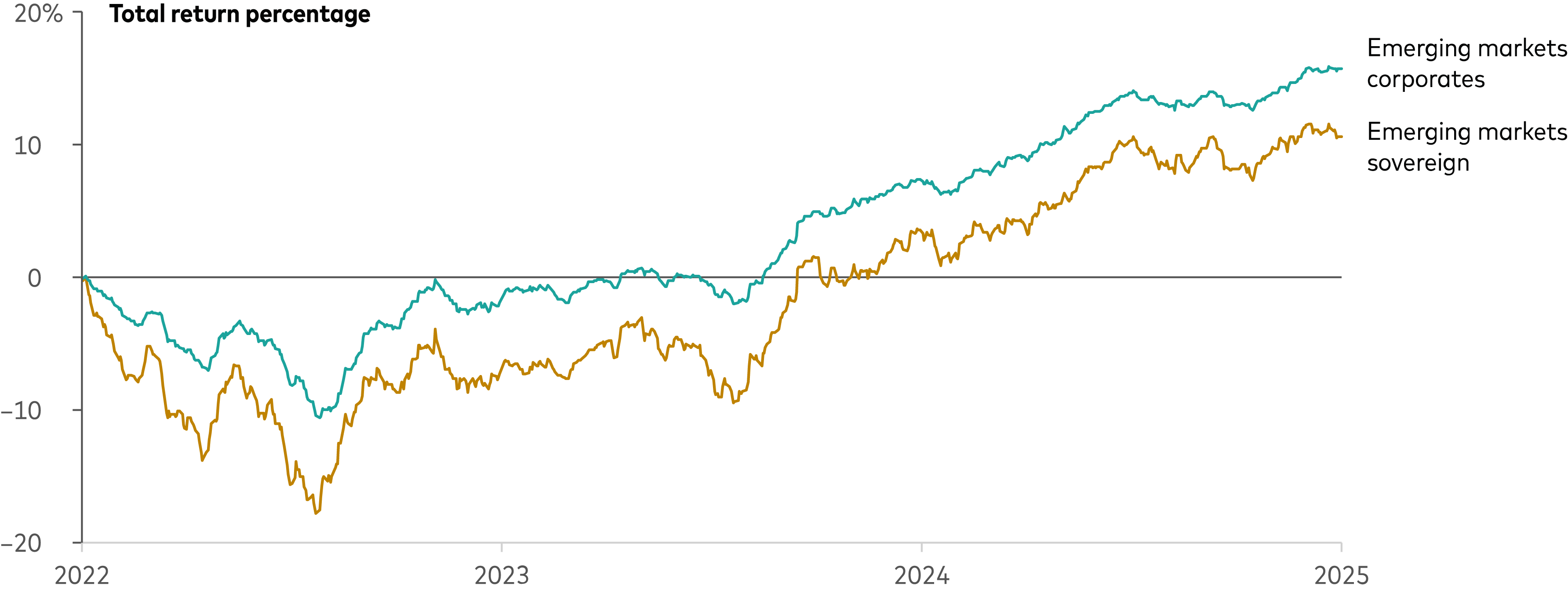
The shorter duration aspect has benefited corporates in the rising rate environment of the past three years. However, we believe that structural tailwind is behind us, and we prefer having exposure to longer-duration assets such as EM sovereigns.
Fundamentals shift?
Before the global financial crisis, the private sector was highly leveraged, leading to significant vulnerabilities within financial markets. In response to the ensuing economic turmoil, the public sector—through sovereign balance sheets—intervened to stabilize the economy via quantitative easing and extensive bailouts. This period saw a revival of financial repression, as governments worldwide implemented strategies to stimulate the private sector. Over the years since 2008, we have witnessed a range of measures designed to foster corporate investment and economic recovery:
- Quantitative easing
- Ultra-low interest rates
- Fiscal stimulus
- Credit facilities
This resulted in a significant improvement in the overall quality of corporate balance sheets over the past decade. However, we believe there is a potential for structural change as the pendulum swings from strong corporate balance sheets to stronger sovereign balance sheets.
In emerging markets, sovereign fundamentals are improving post-COVID, with 2024 upgrades outpacing downgrades 2:1, the highest ratio in 10 years. No defaults are expected in 2025.
On the corporate side, while balance sheets are healthy, optimism has peaked. Sectors such as energy, industrials, autos, and chemicals are deteriorating due to Europe's slowdown and China's overcapacity, causing price pressure and added leverage.
Tariffs add to these challenges and raise a critical question: Will companies’ balance sheets need to absorb the financial pressure, or can they pass these costs on to consumers?
In the United States, recent data point toward lower consumer confidence. This means there is a risk that corporations won’t be able to raise prices to fully reflect higher costs from tariffs, leading to reduced corporate margins and a deterioration of overall balance sheets.
Valuations: EM corporates are expensive, versus both history and sovereign credit
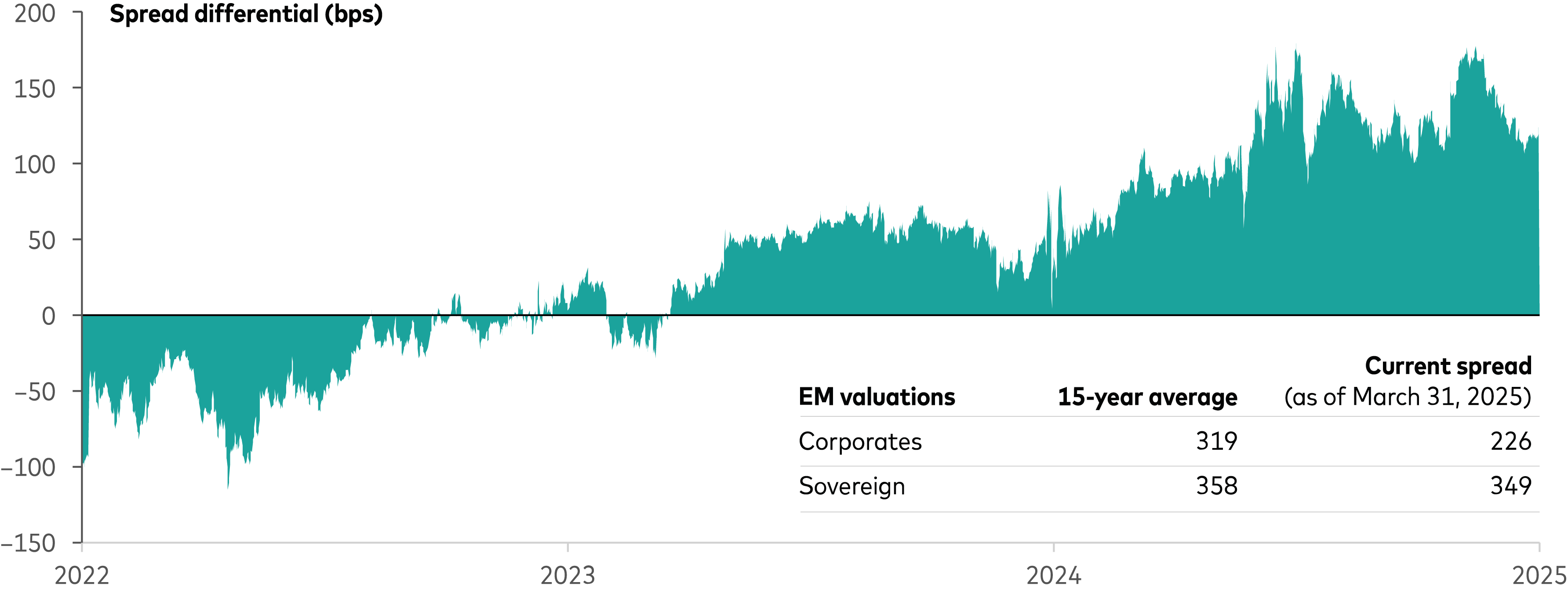
On a historical basis, EM corporates’ valuations (spreads) are tight and through the typical range, while sovereign debt is priced closer to its long-term average.
As EM corporate valuations compressed to a tighter level versus history compared with their sovereign counterparts, we have seen an increasing spread differential between sovereign and corporates over the last 15 years, meaning sovereign debt overall has become more attractively priced on a relative value basis.
Historical spread differential for EM sovereign and EM corporate debt