The labor market is steadier than headlines suggest
5 minute read
Economic & market outlook

The labor market is steadier than headlines suggest

Recent monthly job reports have been unusually volatile. Over the past 10 months, employment growth has oscillated between gains and losses, with negative months often followed by positive ones. The unexpected 133,000‑job decline in February, quickly reversed by a 178,000‑job gain in March, illustrates just how erratic the headline payroll numbers have been. It’s enough to send a labor economist in search of more reliable numbers.

In fact, Vanguard has long tracked labor market indicators beyond the headline job-creation figures released each month by the Bureau of Labor Statistics (BLS). Declining response rates to BLS surveys have reduced the precision of monthly payroll estimates, and private‑sector labor market measures have proven critical during periods of government shutdowns or data collection disruptions.

A surprisingly typical labor market

The widely followed nonfarm payroll report measures total employment across industries using an employer‑based survey. Because different establishments respond each month, the data can fluctuate meaningfully, making it harder to infer the real‑time experience of workers and job‑seekers.

This is why we place greater emphasis on worker flows derived from the household survey, which follow people over time rather than relying on net job counts at firms. In today’s supply‑constrained labor market, shaped by population aging and more limited immigration, these flow measures better capture underlying dynamics and suggest the labor market is behaving much as we would expect in a steadily growing economy. This matters because the labor market’s health is vital to the health of the overall economy and an essential input to Federal Reserve policymaking. A steady job market allows the Fed to focus on inflation, which demands attention amid the recent surge in energy prices.

Historically low layoffs signal a steady labor market

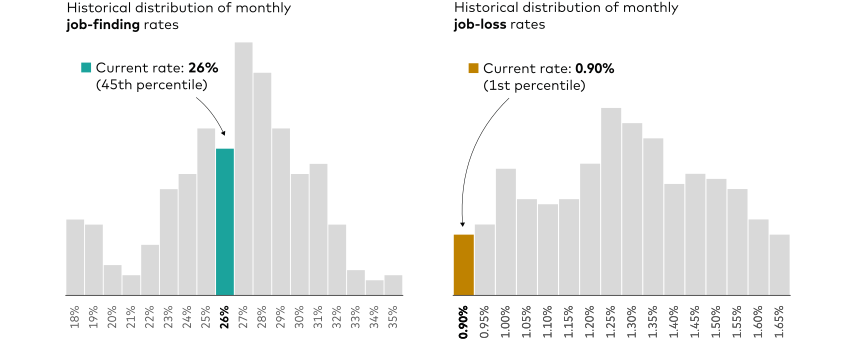
While the monthly BLS report estimates the net monthly change in jobs, worker flows provide a deeper view of labor market dynamics by tracking how individuals move into and out of employment. Two key measures are the job-finding rate, which measures the share of unemployed workers who secure jobs each month, and the job-loss rate, which captures the proportion of employed workers who become unemployed.

The job-finding rate is solid, while the job-loss rate remains unusually low

The job-finding rate is solid, while the job-loss rate remains unusually low

Sources: Vanguard and the Federal Reserve Bank of St. Louis for the period from February 1990 through March 2026.

The job-finding rate—currently around 26%—indicates that unemployed workers are securing jobs at a pace consistent with historical norms, even as the labor market has become more competitive in recent years. Meanwhile, the job-loss rate remains exceptionally low—at less than 1%—highlighting the continued rarity of layoffs and employers’ reluctance to let go of current staff.

Taken together, these measures point to resilient labor demand: Employers remain cautious about expanding headcount, but they are also firmly holding onto the workers they already have.

Nevertheless, some softening is expected

We also look to Vanguard’s own 401(k) retirement plan data, which are administrative and not based on a survey, so the “response rate” is 100%. Based on those data, we estimate that 58,000 jobs were created in April. (The BLS estimate is scheduled to be released on May 8.) 

Today’s labor market appears more resilient than recent payroll swings alone might suggest. Still, headwinds—including higher energy prices, a more cautious consumer, and the pace of AI adoption—are likely to weigh modestly on new job creation. We forecast the unemployment rate to edge up gradually to about 4.6% by the end of 2026.

CFA® is a registered trademark owned by CFA Institute.

Notes:

Vanguard Mexico is not responsible for and does not prepare, edit, or endorse the content, advertising, products, or other materials on or available from any website owned or operated by a third party that may be linked to this email/document via hyperlink.  The fact that Vanguard Mexico has provided a link to a third party's website does not constitute an implicit or explicit endorsement, authorization, sponsorship, or affiliation by Vanguard with respect to such website, its content, its owners, providers, or services.  You shall use any such third-party content at your own risk and Vanguard Mexico is not liable for any loss or damage that you may suffer by using third party websites or any content, advertising, products, or other materials in connection therewith.