Sub-asset allocation
Learn about strategic and tactical uses for ETFs, including asset and sub-asset allocation, portfolio completion, cash equitization and more.
Sub-asset allocation
The weighting of an asset class within a portfolio is often proportional to its weighting in the broad market.
However, for some investors, tilting the concentration within a security, industry sector, market segment or asset class can be a practical way to meet unique objectives. Specialized ETFs can provide the desired tilt.
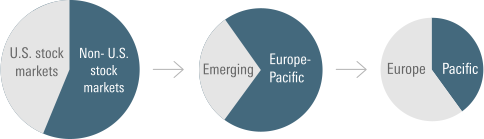
For example, investors who believe that emerging markets will provide higher returns than developed markets might invest a larger proportion of their assets in an emerging markets ETF.
Approximate equity market weights
Investor preference (hypothetical)
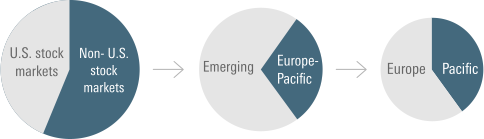
Source: Vanguard. Approximate market weights and investor preferential weights are for illustrative purposes only and shall not be construed as a recommendation to buy or sell any security or financial instrument, or an offer or recommendation to participate in any particular trading or investment strategy.
Points to consider
- Concentration in any security, industry sector, market segment, region or asset class can lead to greater risk relative to a diversified portfolio.
- Foreign investing involves additional risks including currency fluctuation and political uncertainty. ETFs that invest in emerging markets are generally more risky than those that invest in developed countries.
Learn about Active / Passive combinations.
ETF fundamentals
Basics
Learn the basics of ETFs, including their history, how they compare to mutual funds, what types are available and more.
Indexing
Indexing, how ETFs are indexed, the differences between excess return and tracking error, and more.
Trading
Learn how ETFs trade, where they get liquidity, common order types, how premiums and discounts work and more.